
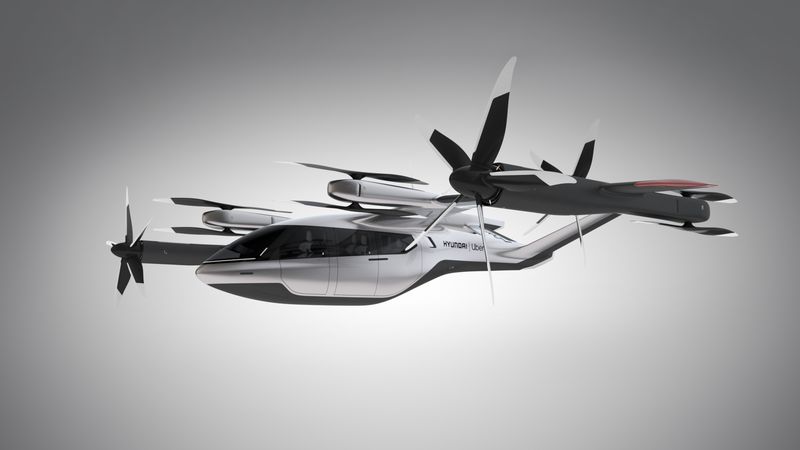
Uber and Hyundai release plans for a flying car

Uber has unveiled its plans, in collaboration with Hyundai Motor Co., for flying cars that will operate as air taxis.

The full-scale prototype of the concept vehicle is on display at the CES technology conference this week.

The flying car is planned to be fully electric, take off and land vertically and be able to seat four passengers. It is expected to fly up to 322 km/h for up to 97 km per charge at around 300-600 meters above the ground. Uber plans to have these vehicles fly autonomously eventually, but have acknowledged the need for a human pilot initially.

The project is part of Uber Elevate, the company’s aerial division.

Alongside the actual vehicle design, Hyundai unveiled concepts for a landing hub and a ground vehicle which will transport people to the flight station. Uber has not released any prices for these flights since the project is still in its early days.

 

The model is the first step, with Hyundai yet to complete any test flights.

According to My Broadband, Uber said it will conduct the first public demonstration of a flying car this year and allow customers to book aerial rides by 2023. It will first launch in the US, in Texas and California.

On top of the actual physical challenge of building the vehicle, Uber and Hyundai will have to negotiate with the Federal Aviation Administration and other aviation regulatory bodies before being allowed to take to the skies.

Image: Uber

Author:  Popular Mechanics

Similar Posts

  • History and Timeline of the Battery

    A battery, which is actually an electric cell, is a device that produces electricity from a chemical reaction. In a one cell battery, you would find a negative electrode; an electrolyte, which conducts ions; a separator, also an ion conductor; and a positive electrode. Timeline of Battery History 1748—Benjamin Franklin first coined the term “battery” to describe an array…

  • The 2020 Olympic Medals Will Be Made from Recycled Gadgets

    The world’s best athletes will wear old cell phones around their necks next summer. The medals awarded during next summer’s Olympic and Paralympic Games in Tokyo—set to kick off July 24, 2020—will be completely made from recycled materials. The Tokyo Organising Committee of the Olympic and Paralympic Games decided to create sustainable medals in an…

  • Vehicle-to-Grid: Using Electric Cars To Store Renewable Energy

    Electric cars that aren’t currently on the move could be used to help stabilise energy grids, make electricity from renewable energy sources more viable and generate extra income for EV owners. That’s the goal of the Munich-based company The Mobility House and their smart Vehicle-to-Grid technology. On average, privately-owned cars are parked for approximately 23…

  • Burglar Alarm Batteries

    Burglar alarms are generally reliable but if the internal battery is flat and will no longer hold charge it should be replaced as soon as possible. A flat internal battery can mean that if there is a power cut the external siren will sound because the hold off circuit to it is no longer present….

  • Load Shedding Solutions

    Load Shedding ( The reasons we are given) Load shedding is a cost-effective, emergency rotating method of energy distribution that has been quite helpful to ease the problems of lack of power generation South Africa is facing from time to time. Eskom developed this  method to prevent blackout scenarios building a “power reserve” for critical…

  • Gate Motor Battery

    In the vast majority of motors, batteries are used to drive the motor. To say that they are battery back-up motors is therefore incorrect, as the battery is always in use; not exclusively in the event of a power failure. If the battery is disconnected, the motor will not work. In the vast majority of…

Leave a Reply

Your email address will not be published. Required fields are marked *